Everyone knows 911 compliance is required. Fewer people know what happens when you're not compliant.
The short answer: it's expensive. And it just got more urgent. In April 2026, the U.S. House of Representatives passed the Kari's Law Reporting Act (H.R. 5201) in a near-unanimous 405–5 vote, directing the FCC to audit and publicly report on enterprise compliance with Kari's Law. The era of "no one is checking" is officially over. But FCC scrutiny is only the beginning — non-compliance creates exposure across multiple dimensions: regulatory penalties, civil liability, operational disruption, and reputational damage.
Here's what 911 non-compliance actually costs.
The Regulatory Penalties
The FCC has authority to impose forfeitures (fines) for violations of Kari's Law and Ray Baum's Act. The penalty structure is straightforward but adds up quickly.
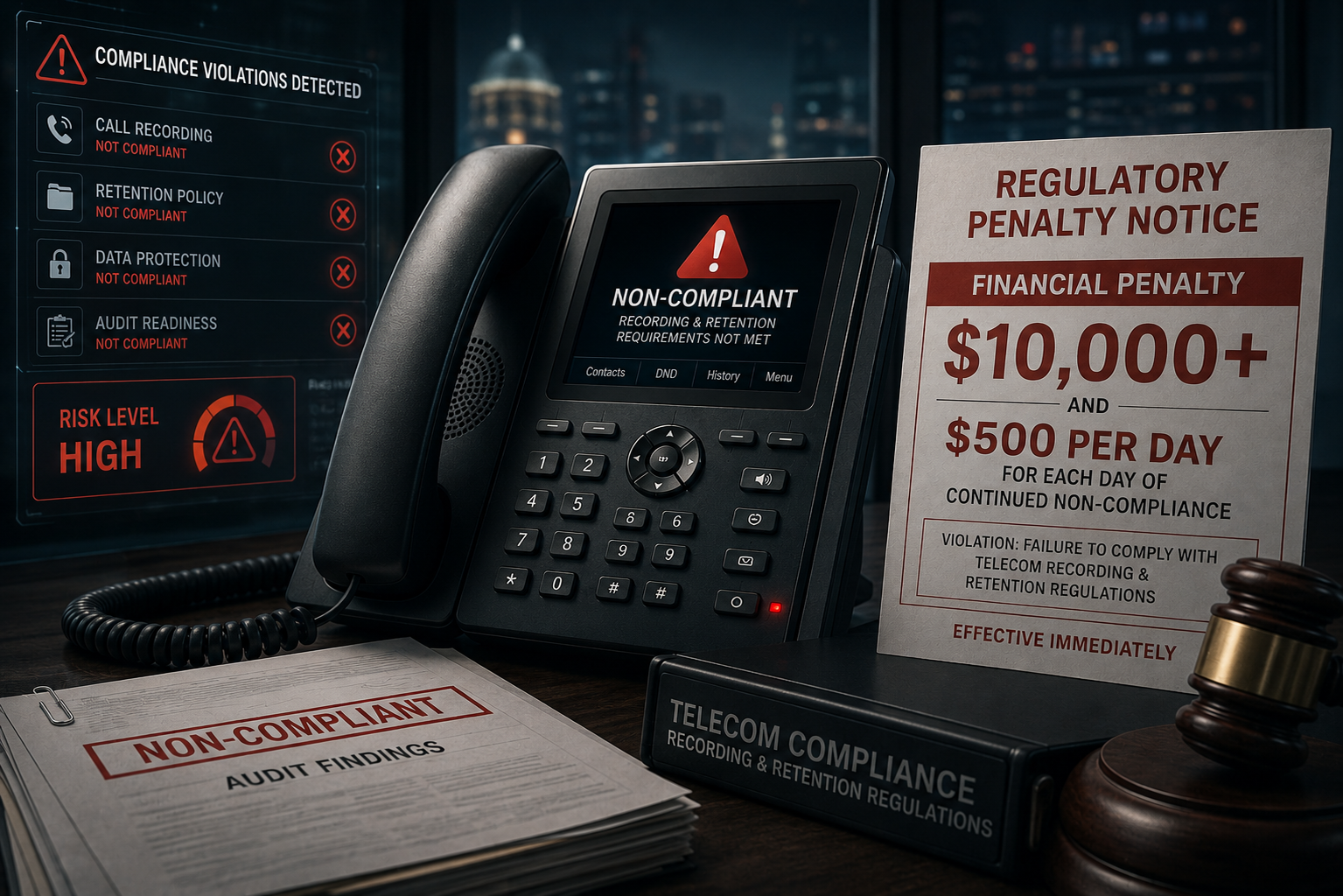
Base penalties start at $10,000 per violation.
A "violation" isn't one phone that can't reach 911. It's each instance of non-compliance. If your system prevents direct 911 dialing across 50 phones, that's potentially 50 violations. If your location data is inaccurate for 200 users, that's 200 violations.
Continuing violations add $500 per day.
Once you know about a violation and fail to fix it, each day of continued non-compliance adds to the total. A location data problem that persists for six months while you "work on a solution" compounds into significant additional liability.
The math gets bad quickly.
Consider a mid-size organization with 500 employees across three buildings. An audit reveals:
- 500 users can't dial 911 without a prefix (Kari's Law violation)
- 350 users have inaccurate or missing location data (Ray Baum's Act violation)
- The issues have existed for 90 days since the last system change
Theoretical maximum exposure: 850 violations × $10,000 = $8.5 million base, plus 850 × 90 × $500 = $38.25 million in continuing penalties.
In practice, the FCC typically doesn't pursue maximum penalties. But the statutory authority exists, and the numbers demonstrate why compliance matters.
New: The Kari's Law Reporting Act Changes the Game
Until now, many organizations treated 911 compliance as a theoretical risk. Enforcement was real but inconsistent, and plenty of enterprises operated under the assumption that no one was actively checking. That assumption just became a lot more dangerous.
On April 21, 2026, the U.S. House of Representatives passed the Kari's Law Reporting Act (H.R. 5201) by a vote of 405–5. The bill directs the FCC to publish a comprehensive report — within 180 days of enactment — on how well multi-line telephone system (MLTS) manufacturers and vendors are complying with the original Kari's Law requirements. This isn't a new regulation. It's an accountability mechanism for the regulation that already exists.
What the FCC report will cover.
The legislation requires the FCC to report on the extent to which MLTS manufacturers and vendors have complied with Kari's Law's direct-dialing and notification requirements. That means the FCC will be formally evaluating whether the phone systems enterprises purchase and deploy actually allow users to dial 911 without a prefix and whether those systems support the required on-site notification when a 911 call is made. If your MLTS vendor sold you a non-compliant system, the FCC's report could name them — and by extension, highlight the organizations still running those systems.
Why this matters for enterprises right now.
The Kari's Law Reporting Act signals a clear shift from "comply because it's the law" to "comply because someone is checking." Once the FCC publishes its compliance findings, the results become public record. Non-compliant vendors will be exposed. And enterprises still running those systems will face uncomfortable questions from regulators, insurers, and legal counsel alike. If compliance gaps are widespread — which many in the industry expect — the report could be the catalyst for a wave of enforcement actions, using the penalty structure already on the books.
The 180-day clock is ticking.
Once the bill is signed into law, organizations will have a finite window before the FCC's findings go public. That window is the time to get compliant — or to confirm and document that you already are. Waiting until after the report drops means reacting to scrutiny instead of getting ahead of it.
The Civil Liability
Regulatory fines are predictable. Lawsuits are not.
When a 911 call fails and someone is harmed, the organization operating the phone system faces potential civil liability. These cases don't have statutory caps — damages are determined by the circumstances.
Wrongful death claims.
If someone dies because 911 responders went to the wrong location or couldn't be reached at all, the organization may face a wrongful death lawsuit. Damages in these cases routinely reach seven figures, and settlements or verdicts can go much higher depending on the circumstances.
Personal injury claims.
Non-fatal outcomes still create liability. Delayed response due to inaccurate location data, failed notification that prevented internal assistance, inability to reach 911 in an emergency — all of these can form the basis of personal injury claims.
Negligence arguments write themselves.
Plaintiff's attorneys don't need to be creative when federal law explicitly requires direct 911 access and accurate location data, and the organization failed to provide either. The existence of Kari's Law and Ray Baum's Act establishes a clear standard of care. Failure to meet that standard is negligence almost by definition.
Insurance may not cover everything.
General liability policies often have exclusions or sublimits for regulatory violations. Even if a policy covers the civil claim, the organization may be on the hook for fines, remediation costs, and legal fees that exceed coverage.
The Operational Costs
Getting caught non-compliant triggers immediate operational expenses beyond the penalties themselves.
Emergency remediation.
When an audit or incident reveals compliance gaps, organizations typically scramble to fix them. Emergency projects cost more than planned implementations — expedited timelines, overtime, premium pricing for urgent vendor support. Organizations that work with a dedicated E911 compliance partner like 9Line avoid this entirely by getting it right from the start.
System replacement or upgrade.
Sometimes the existing phone system can't be made compliant without significant changes. Organizations have been forced into unplanned capital expenditures to replace systems that couldn't meet requirements.
Ongoing monitoring requirements.
Consent decrees and settlement agreements often include compliance monitoring provisions. The organization must demonstrate ongoing compliance through regular reporting, third-party audits, or both — all at their own expense.
Internal investigation costs.
When something goes wrong, organizations typically conduct internal investigations to understand what happened and why. Legal counsel, technical consultants, and executive time all have costs.
The Reputational Impact
Compliance failures become public in multiple ways.
FCC enforcement actions are public record.
When the FCC issues a citation, proposes a forfeiture, or enters a consent decree, the documents are publicly available. Industry publications cover significant enforcement actions. Your customers, partners, and competitors can see exactly what happened.
Lawsuits are public.
Civil complaints are filed in court and become part of the public record. Even cases that settle often have public filings that describe the allegations in detail.
News coverage amplifies incidents.
A failed 911 call with serious consequences often generates local news coverage. "Employee couldn't reach 911" is a story that writes itself. The organization's name is attached to that story permanently.
Customer and employee trust erodes.
People expect 911 to work. When they learn their employer or service provider couldn't guarantee that basic safety function, trust diminishes. For organizations in regulated industries or those that emphasize safety culture, this reputational damage can affect business relationships and recruiting.
Real-World Enforcement Examples
The FCC has pursued enforcement actions across multiple categories of 911 violations.
Carrier outages.
Telecommunications carriers have faced eight-figure penalties for 911 outages affecting large numbers of calls. While these cases involved service providers rather than enterprises, they demonstrate the FCC's willingness to impose substantial fines for 911 failures.
Notification failures.
Organizations have been cited for failing to provide the internal notification required by Kari's Law. When someone calls 911, designated personnel must be alerted — and the FCC has pursued cases where this didn't happen.
Location accuracy issues.
Ray Baum's Act violations related to inaccurate or missing location data have generated enforcement attention. The requirement for "dispatchable location" is specific, and organizations that can't meet it face exposure.
The Hidden Cost: Near Misses
Most compliance failures don't result in tragedy. Someone calls 911, the response is delayed or misdirected, but ultimately things work out. No one dies. No lawsuit follows.
These near misses are the most common outcome — and the most dangerous.
Near misses create false confidence.
When a non-compliant system "works" most of the time, organizations assume they're fine. They delay remediation because nothing bad has happened yet. Each successful call despite the compliance gap reinforces the decision to defer action.
Near misses are still violations.
The FCC doesn't require a tragedy before taking action. The violation exists whether or not someone was harmed. An audit or complaint can trigger enforcement regardless of outcomes.
Near misses accumulate.
Every day a non-compliant system operates is another day of exposure. The continuing violation penalties keep running. The probability of a serious incident increases with each 911 call the system handles.
Organizations that wait for something bad to happen before addressing compliance are playing a dangerous game with compounding stakes. The right E911 partner eliminates the guesswork — 9Line helps organizations identify and close compliance gaps before a near miss becomes a headline.
The Cost of Compliance vs. Non-Compliance
Compliance has costs — technology, implementation, ongoing management. But those costs are predictable and controllable.
Non-compliance costs are unpredictable and potentially unlimited. A single serious incident can generate liability that dwarfs any reasonable compliance investment.
Consider the comparison:
Compliance investment:
- E911 solution implementation: $10,000–$50,000 depending on size
- Annual maintenance and updates: $5,000–$20,000
- Staff time for location data management: Ongoing but manageable
Non-compliance exposure:
- FCC fines: $10,000+ per violation, plus $500/day continuing
- Civil liability: No cap, routinely six to seven figures
- Emergency remediation: Premium costs for rushed implementation
- Reputational damage: Unquantifiable but real
The math is clear. Compliance is the better investment. Solutions like 9Line make that investment predictable — a known cost that eliminates the unknowns.
What Organizations Should Do
If you're uncertain about your compliance status, the time to act is now — before the FCC's Kari's Law compliance report makes the answer public for you. Here's where to start.
Assess your current state. Can every user dial 911 directly without a prefix? Does every 911 call deliver accurate location data? Is someone notified internally when a 911 call is placed?
Document your compliance. If you are compliant, prove it. Maintain records of your configuration, testing results, and location data management processes.
Fix gaps immediately. If you find issues, remediate them. Don't wait for a project budget or a convenient implementation window. The exposure exists today.
Implement ongoing management. Compliance isn't one-time. Location data must be maintained as people move and organizations change. Build processes that keep you compliant over time.
Partner with a compliance expert. With the FCC's compliance audit on the horizon, this is not the time to go it alone. Work with a specialist who understands the full scope of Kari's Law, Ray Baum's Act, and the new Reporting Act requirements — and who can move fast enough to get you audit-ready before the 180-day clock runs out.
How 9Line Helps
9Line provides enterprise E911 solutions purpose-built for Kari's Law and Ray Baum's Act compliance. Every feature maps directly to the requirements the FCC will be auditing.
Direct 911 dialing. 9Line ensures every user on your multi-line telephone system can reach 911 without dialing a prefix, an access code, or any additional digits — the core requirement of Kari's Law and the first thing the FCC's report will evaluate.
Accurate dispatchable location. 9Line delivers precise, dispatchable location data with every 911 call — building, floor, wing, room — so first responders arrive at the right place. This satisfies Ray Baum's Act requirements and eliminates the location accuracy gaps that drive both FCC enforcement and civil liability.
On-site notification. When a 911 call is placed, 9Line automatically alerts designated on-site personnel — security teams, facilities managers, front desk staff — so your internal response can begin immediately, not after emergency services arrive. This is a Kari's Law requirement that many organizations overlook.
Ongoing location data management. Compliance isn't a one-time project. People move desks, floors get reconfigured, offices open and close. 9Line provides the tools and processes to keep location data accurate over time, so your compliance doesn't degrade the moment your initial deployment is complete.
Compliance audits and documentation. Not sure where you stand? 9Line can assess your current environment, identify gaps, and provide the documentation you need to demonstrate compliance — whether for your own records, your legal team, your insurers, or an FCC inquiry.
The Kari's Law Reporting Act makes one thing clear: the federal government is done assuming enterprises are compliant. 9Line helps you prove that you are — and stay that way.
The Bottom Line
911 non-compliance is expensive. Fines, lawsuits, remediation costs, reputational damage — the total can easily reach seven figures for a single serious incident. And with the Kari's Law Reporting Act now directing the FCC to formally audit enterprise compliance, the likelihood of getting caught just increased dramatically.
Compliance costs money too. But it's a fraction of the alternative, and it's entirely within your control.
The organizations that take 911 seriously don't do it because of the penalties. They do it because keeping people safe is the right thing to do. The fact that it also protects the organization from catastrophic liability is just a bonus.
The cost of compliance is predictable. The cost of non-compliance is not. The FCC is about to start checking. Choose wisely — and if you need a partner, 9Line is ready to help.