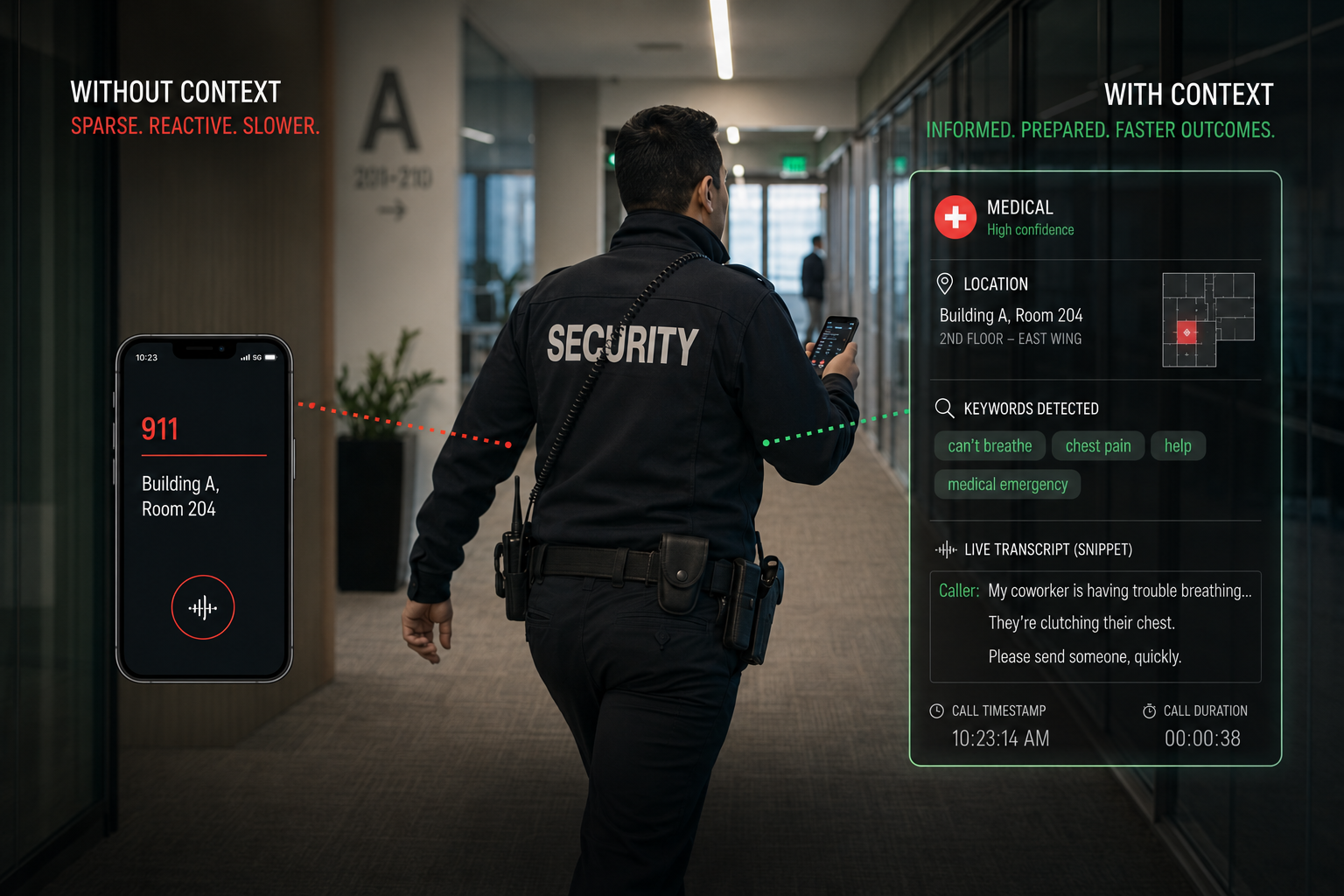
The alert hits: "911 call, Building A, Room 204."
Your security team starts moving. They're trained for this. But as they head toward Room 204, they're missing something critical — context.
Is it a medical emergency? A fire? A threat? The notification told them where. It didn't tell them what.
For years, this was acceptable. Notification was the standard because it was the best available option. But the standard is changing. Organizations are realizing that getting their team to the right location isn't enough. They need to arrive prepared.
The Notification Gap
Most enterprise 911 systems do one thing well: they tell you a call happened and where it originated. That's valuable — it's a legal requirement under Kari's Law — but it's incomplete.
Think about what your security team actually needs when responding to an emergency:
What type of emergency is it? Medical, fire, and security incidents require completely different responses. Different equipment, different approaches, different backup.
How serious is it? A minor injury and a cardiac arrest both generate 911 calls. The urgency is not the same.
Is it escalating? Some situations are stable. Others are getting worse by the second. Knowing the trajectory matters.
Who's involved? One person? Multiple? Is the caller the victim or a bystander?
Are there hazards? Weapons, fire, chemical exposure — information that affects how responders approach the scene.
Basic notification provides none of this. Your team gets a location and starts guessing.
The Cost of Arriving Blind
When responders don't know what they're walking into, several things can go wrong:
Wrong equipment. They grabbed the AED for a fire. They brought a first aid kit to a security threat. Now they're backtracking while the situation develops.
Wrong posture. They approached casually for what turns out to be a violent situation. Or they approached tactically for a routine medical call, causing unnecessary alarm.
Wrong team size. They responded solo to a multi-victim incident. Or they pulled the entire team away from their posts for something one person could handle.
Wrong escalation. Without knowing the severity, they either over-react (full evacuation for a minor incident) or under-react (delayed backup for a serious situation).
These aren't edge cases. They're the natural result of making response decisions without information. Your team is doing their best with what they have — they just don't have much.
What Changes with Context
Imagine the same scenario with context added:
Alert: "911 call, Building A, Room 204. MEDICAL — Keywords detected: chest pain, difficulty breathing, collapsed."
Now your team knows:
- Bring the AED and medical kit
- Move fast — cardiac symptoms are time-critical
- One person is enough for initial response, but EMS will need to be met at the entrance
- No security threat, no need for tactical approach
Or consider:
Alert: "911 call, Building A, Room 204. SECURITY — Keywords detected: threatening, weapon, scared, hiding."
Completely different response:
- Do not approach alone
- Coordinate with other security personnel
- Consider lockdown procedures for surrounding areas
- Brief law enforcement when they arrive
Same location. Same notification trigger. Entirely different situations requiring entirely different responses.
The context doesn't come from magic. It comes from the actual words being spoken on the 911 call — words that, until now, only the dispatcher could hear.
How Real-Time Context Works
When someone calls 911, they describe the emergency. "My coworker collapsed." "There's smoke coming from the break room." "Someone's threatening people in the lobby."
This information flows to the dispatcher, who uses it to determine what resources to send. Police, fire, EMS — the dispatcher knows what's needed because they heard the caller describe it.
With the right technology, your security team can access this same information in real time.
Here's how it works with Echo:
1. Call detection.
When a 911 call is placed, Echo immediately identifies it and begins monitoring.
2. Real-time transcription.
The audio is transcribed as the call happens — not after it ends.
3. Keyword analysis.
AI-powered semantic detection identifies keywords and phrases that indicate emergency type, severity, and hazards.
4. Contextual alert.
Your team receives an enhanced notification that includes not just location, but emergency category and relevant keywords.
5. Ongoing updates.
As the call continues, new information flows to your team. If the situation escalates, they know immediately.
The result: your responders know what they're responding to before they arrive.
What Security Teams Actually See
With Echo, a 911 alert transforms from a simple location ping to an actionable intelligence feed:
Basic notification (traditional):
911 call placed — Building A, Room 204 — 2:34 PM
Enhanced notification (with Echo):
🔴 MEDICAL — Building A, Room 204 — 2:34 PM
Keywords: chest pain, not breathing, collapsed
Transcript: "...he just grabbed his chest and fell... he's not responding..."
Your team sees at a glance:
- Emergency type: Medical
- Severity indicators: Not breathing, collapsed
- Context: Apparent cardiac event
They're not guessing. They're responding with purpose.
Beyond the Initial Alert
Context isn't just valuable at the moment of dispatch. It continues to matter as the situation unfolds.
Situation changes. What started as a medical call might reveal foul play. What seemed like a false alarm might escalate. Echo continues monitoring the call, updating your team as new information emerges.
Coordination improves. When professional responders arrive — police, fire, EMS — your team can brief them on what's happening inside. "Cardiac arrest, third floor, Room 204, CPR in progress." That's more useful than "someone called 911 from Room 204."
Incident documentation. The transcript and keyword log become part of your incident record. For post-incident review, compliance documentation, or legal purposes, you have a clear timeline of what was communicated and when.
Pattern recognition. Over time, you build data on emergency types, locations, and responses. This informs training, resource allocation, and facility planning.
The Shift from Reactive to Informed
Traditional 911 notification is reactive. Something happened, you get pinged, you respond and figure it out when you arrive.
Contextual awareness is informed. Something happens, you immediately understand what kind of situation it is, and you respond accordingly.
This isn't about replacing professional first responders. Police, fire, and EMS are still coming. But in the minutes before they arrive — minutes that matter enormously in cardiac events, fires, and security incidents — your internal team is the first line of response.
They deserve more than a location ping.
Making the Transition
If your current 911 infrastructure only provides basic notification, upgrading to contextual awareness requires:
Real-time call monitoring. The technology to capture and process 911 calls as they happen, not after the fact.
AI-powered analysis. Keyword detection that understands context, not just literal matches. "He grabbed his chest" and "heart attack" should trigger the same medical alert.
Integration with existing systems. Alerts should flow to your security operations center, notification platforms, and mobile devices — wherever your team needs them.
Privacy-conscious design. Call monitoring for emergency purposes, with appropriate controls and data handling.
Echo provides all of this, integrated natively with the 9Line platform. No separate hardware. No complex integration projects. Just better information when it matters most.
The Bottom Line
Your security team already responds to 911 calls. The question is whether they respond informed or uninformed.
Basic notification tells them where to go. Contextual awareness tells them what they're walking into.
When someone in your building has a cardiac emergency, when there's smoke on the third floor, when a threat emerges in the lobby — those are the moments when the difference between notification and context becomes the difference between a prepared response and a blind one.
Your team is already running toward the emergency. Give them what they need before they arrive.
911 notification was the standard. Real-time situational awareness is what's next. Echo makes the difference.