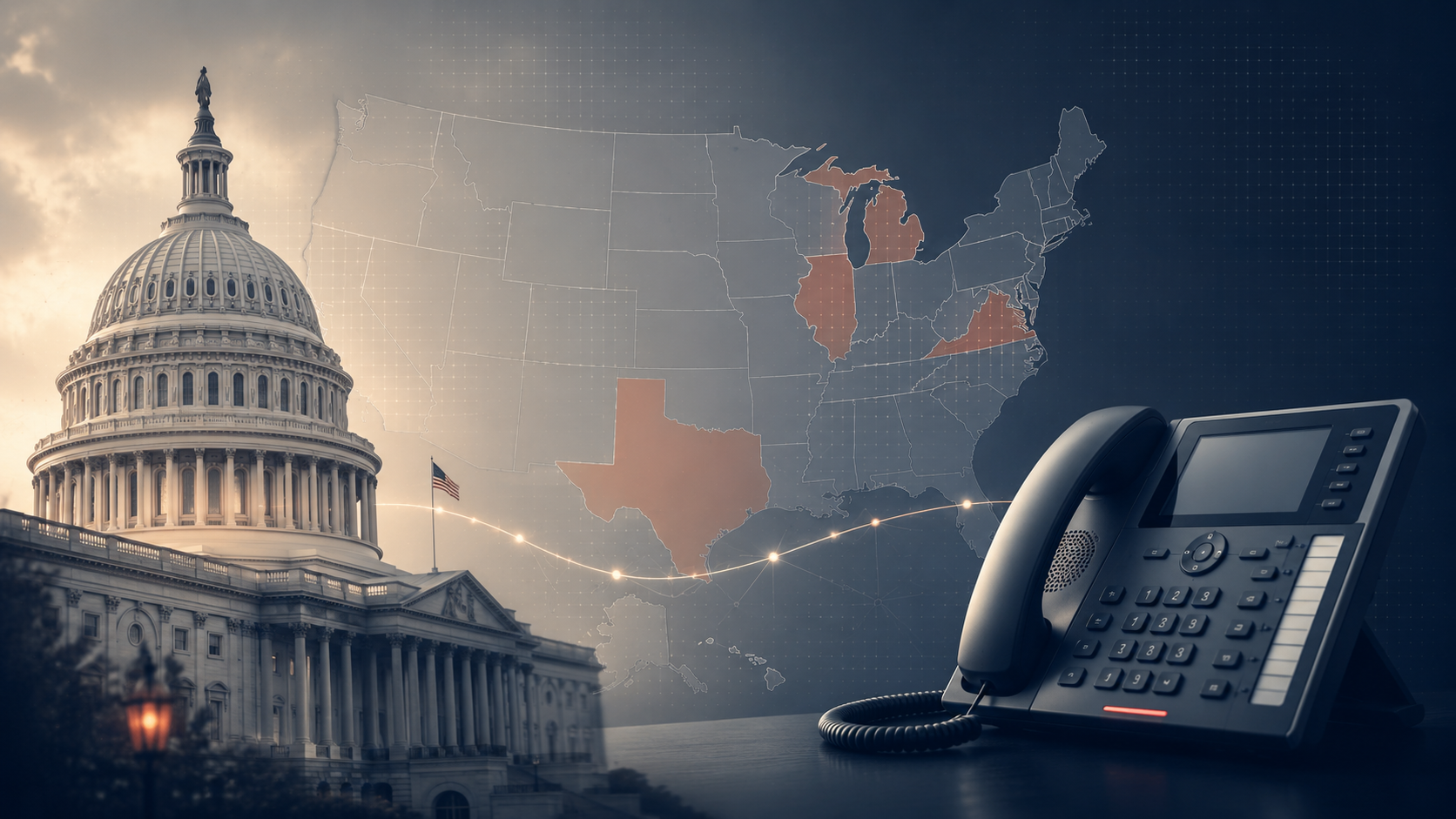
On April 21, the U.S. House passed the Kari's Law Reporting Act by a vote of 405–5. The bill, H.R. 5201, doesn't change the underlying federal mandate that businesses' phone systems allow direct 911 dialing — that law has been on the books since 2018. What it does is order the FCC to publish a report, within 180 days of enactment, on whether anyone is actually complying.
It's an oversight measure, not a rewrite. But the lopsided vote signals something worth paying attention to: nearly eight years after Kari's Law was signed and more than six years after the FCC's implementation deadline, Congress isn't sure the law has teeth. The Reporting Act is essentially Washington saying, show us the receipts.
For organizations that operate large phone systems — hotels, hospitals, university campuses, corporate headquarters — the answer to "are you compliant?" isn't just a matter of the 2018 federal law. It's a matter of federal law plus whatever your state has stacked on top. And in many states, what's stacked on top is significant.
Michigan is one of those states.
The Federal Floor: Kari's Law and RAY BAUM's Act
Kari's Law is named for Kari Hunt, who was killed in a Texas motel in 2013. Her nine-year-old daughter tried to call 911 four times from the room phone, but the calls never connected — the motel's phone system required dialing "9" for an outside line first, and no one had told the child. Congress responded with the Kari's Law Act of 2017, signed in February 2018. The FCC's implementing rules took effect February 16, 2020.
The federal mandate has two parts:
- Direct 911 dialing. Any multi-line telephone system (MLTS) manufactured, sold, or significantly upgraded after the effective date has to let users dial 911 without a prefix, access code, or "dial 9 first." If the device can order a pizza, it has to be able to call 911 the same way.
- On-site notification. When 911 is dialed, the system must alert a central location — front desk, security office, an administrator's email or pager — so someone on the premises knows an emergency is in progress and can meet first responders at the door.
A companion law, Section 506 of RAY BAUM's Act, adds the location piece. Every 911 call has to deliver a "dispatchable location" to the Public Safety Answering Point (PSAP): street address plus enough detail — building, floor, suite, room — for responders to find the caller without guessing. RAY BAUM's also covers non-fixed devices: softphones, mobile clients, remote workers on company VoIP.
Together, these are the federal floor. The Kari's Law Reporting Act is going to measure how often that floor is actually being met.
Michigan Public Act 30: The State Goes Further
Michigan adopted Public Act 30 on June 25, 2019, replacing earlier Michigan Public Service Commission rules. The statute is codified at MCL 484.901 and sits under Michigan's Emergency 911 Service Enabling Act. With some exceptions, the requirements took effect December 31, 2020.
The core mandate is that operators of any MLTS or PBX must route 911 calls and specific location information to the appropriate local PSAP. A street address alone isn't enough — the PSAP needs the building, the floor, and ideally the room or zone. And the requirements scale with how big and complex the facility is.
Location Requirements by Facility Size
This is where Michigan gets more prescriptive than the federal rules:
- Single building, single floor, over 7,000 square feet of workspace. Report street address plus the specific location of the calling device within the building.
- Single building, multiple floors. Same as above, plus the floor number for any multi-story structure.
- Multiple buildings sharing one MLTS. Systematically report the street address (including unique addresses where buildings have them), a unique building identifier, and the specific location of the device. Floor numbers required for multi-story buildings.
"Workspace" means the physical area where work is normally performed — offices, production areas, warehouses, shop floors, storage, hallways, conference rooms, break rooms. It excludes wall thickness, shafts, HVAC, and similar non-occupied space.
Exemptions
- Small-building exemption. Buildings with less than 20,000 square feet of workspace and fewer than 20 communications devices are exempt from the specific-location requirement until the operator installs a new MLTS after January 1, 2020.
- 24-hour on-site response. If the building maintains a round-the-clock alternative system capable of locating any device that dialed 911 — or has its own dedicated medical, fire, and security personnel — it's exempt.
- No enhanced 911 available. Operators not currently served by E911 are exempt until the service becomes available.
- Farms and houses of worship are exempt, though the house-of-worship exemption does not extend to attached schools.
Enforcement
MLTS operators in violation can be fined by the Michigan Public Service Commission from $500 to $5,000 per offense. "Per offense" is the part that should focus attention: that's per non-compliant device, per incident — not a one-time slap. For a campus with thousands of endpoints, the theoretical exposure stacks fast.
How the Federal and State Rules Interact
Michigan PA 30, Kari's Law, and RAY BAUM's Act are complementary but not identical. Three overlapping circles:
- Kari's Law handles direct dialing and notification. Michigan's law doesn't explicitly require notification — that's a federal-only requirement.
- RAY BAUM's Act handles dispatchable location (address plus floor/suite/room). Michigan's law has its own location-granularity requirement that predates RAY BAUM's and uses different terminology ("specific location" and "Emergency Response Location" instead of "dispatchable location"), but the practical outcome overlaps.
- Michigan PA 30 adds what the federal laws don't: the 7,000-square-foot threshold trigger, the per-offense fine structure, and the tiered requirements that scale by building count and square footage.
The net effect: a Michigan-based organization has to satisfy all three simultaneously. The federal laws set the floor; Michigan raises it in specific places.
The Patchwork: Michigan Is Not Alone
Roughly twenty states had their own MLTS E911 statutes on the books before the FCC finalized the federal rules, and most still do. The result is a patchwork where the same phone system might be compliant in one state and short of the mark in another. A few examples of how thresholds and penalties vary:
- Illinois triggers location-information requirements at 40,000 square feet and can fine enterprises up to $5,000 for noncompliance.
- Washington uses a 25,000-square-foot threshold.
- Virginia uses a 7,000-square-foot threshold like Michigan, but its statute carries no penalty provisions — a compromise that was needed to get the bill passed.
- Texas requires businesses using a publicly or privately owned switch to provide location and number information for each 911 call, and Tarrant County has its own additional regulations layered on top.
- Tennessee requires Shared Tenant Service Providers to deliver Automatic Number Identification (ANI) and current Automatic Location Identification (ALI) on every 911 call.
- Massachusetts, Minnesota, Mississippi, Maine, Vermont, Louisiana, Kentucky, Arkansas, Colorado, Connecticut, Florida, New Hampshire, Oklahoma, and Alaska all have their own statutes or regulations, each with their own thresholds, definitions, and enforcement.
Square-footage thresholds have been ratcheting downward over the years — what started at 40,000 in some states has been pulled to 25,000, then to 7,000. The trend is toward more granular location reporting, more devices in scope, and fewer organizations able to claim exemption.
What the FCC Report Will — and Won't — Cover
The Kari's Law Reporting Act focuses narrowly on manufacturer and vendor compliance with the original 2018 federal law. The FCC will be asked to summarize how well the companies that build and sell MLTS equipment have configured their systems to support direct 911 dialing out of the box.
What it won't directly cover is the broader state-level picture — whether enterprises operating in Michigan are hitting the 7,000-square-foot threshold rules, whether Illinois fines are actually being collected, whether the patchwork is producing consistent results for callers who don't know which state's rules apply to the building they're standing in.
But the report's framing matters even if its scope is limited. If the FCC comes back and says compliance is high, the bill becomes a footnote and the state laws keep doing the work of filling gaps. If compliance is low — and there's reason to think it might be, given how little public enforcement action the FCC has taken since the 2020 deadline — Congress will be under pressure to add penalties, extend reporting requirements, or push for more aggressive enforcement. Either outcome reshapes the regulatory environment for everyone running an MLTS.
What This Means in Practice
For an enterprise operating a large modern campus — multiple buildings, multiple floors, thousands of endpoints, plus a remote and hybrid workforce on softphones — the compliance footprint is the union of every applicable rule:
- Street address per building (where addresses differ)
- A unique building identifier for each structure
- Floor number for every multi-story building
- Specific location for every communications device
- Direct 911 dialing from any device that can place a call
- Notification to a designated central location when 911 is dialed
- Dispatchable location for off-premises and non-fixed devices, including softphones and remote workers
Federal rules set the floor, Michigan stacks more on top, and other states do the same in their own way. None of these requirements override each other — they pile up. For multi-state operators, the practical compliance bar is whichever rule is strictest in each location, applied everywhere a device might ring.
The Reporting Act doesn't change any of that. But it does signal that the era of "the federal deadline came and went and nobody really checked" is closing. Whatever the FCC report says when it lands, organizations that have been treating Kari's Law and the state overlays as a low-priority IT line item are about to find themselves in a more interesting conversation.
The clock on the federal rules ran out in February 2020. The clock on Michigan's rules ran out in December 2020. The clock on whether anyone was watching is the one that just started ticking.