A minute-by-minute look at what happens after someone dials 911 — and how real-time transcription and keyword alerting change the picture on your side of the door.
When someone in your building dials 911, a chain reaction begins. Dispatchers, databases, first responders, and (ideally) your own team all start moving. Some of it happens in seconds. Some of it takes longer than you'd expect.
Understanding this timeline isn't just interesting — it's practical. When you see where delays happen, and where information goes missing, you can start to address them. That's exactly where Echo, 9Line's real-time transcription and keyword alerting layer, fits in: it turns the 911 call itself into a live source of truth for the people on your side of the door.
Here's what actually happens in the first five minutes after a 911 call — and where Echo changes the picture.
0:00 – The Call Initiates
The caller dials 911. For landlines and most VoIP systems, the call routes based on the registered address associated with that phone. For cell phones, it routes based on cell tower location and GPS data.
Within 1–2 seconds, the call reaches a Public Safety Answering Point (PSAP) — the local 911 call center responsible for that geographic area. The U.S. has roughly 6,000 PSAPs, each covering a specific region.
What can go wrong: If the caller is using a VoIP phone with an outdated registered address — say, they moved floors or started working remotely — the call may route to the wrong PSAP entirely. This happens more often than most organizations realize. 9Line's core platform solves this by delivering a dispatchable location with every call.
0:02 – 0:15 – The Dispatcher Answers
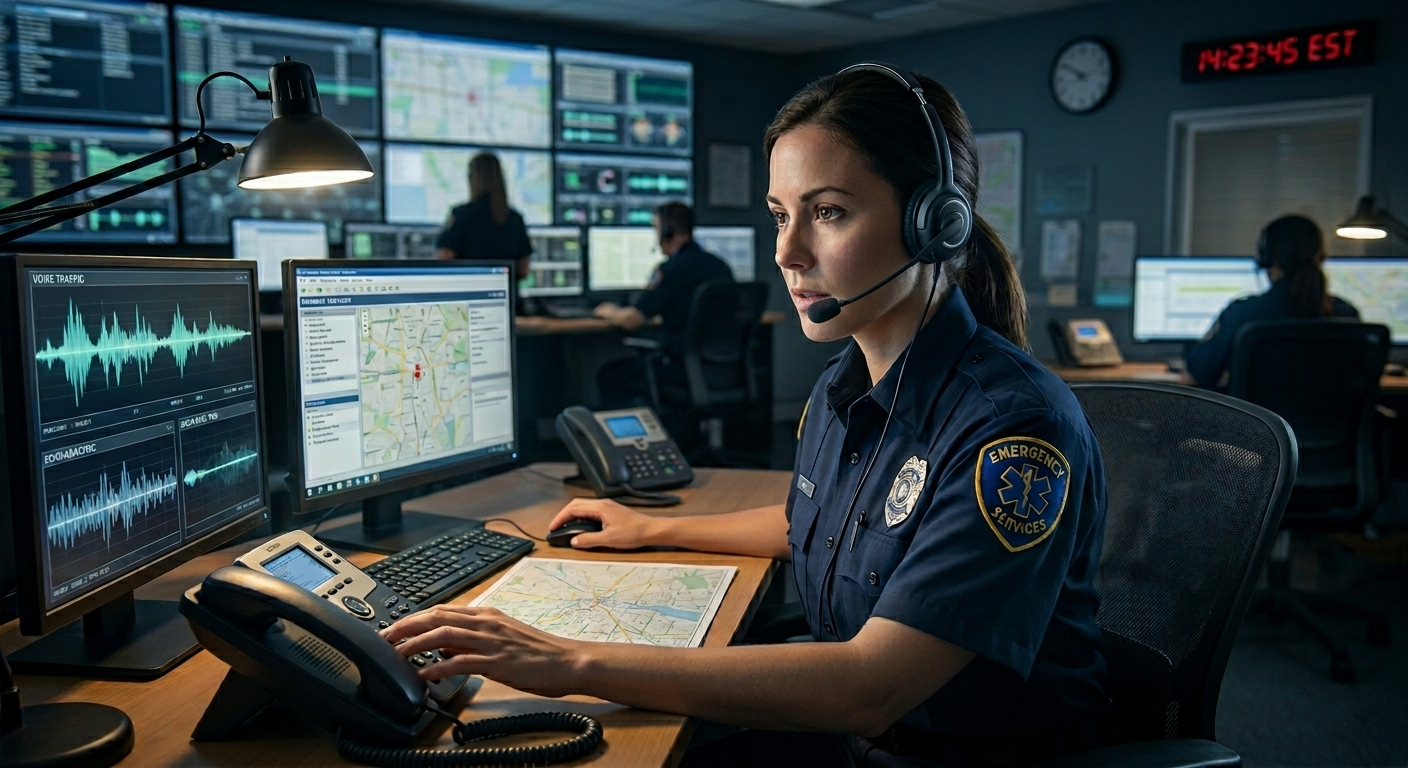
A 911 dispatcher picks up. Their screen populates with whatever information the system delivers automatically: the callback number, and ideally, the caller's precise location.
The dispatcher's first question is almost always: “911, what's your emergency?”
They're trained to gather critical information quickly:
• What's happening?
• Where is it happening?
• Is anyone injured?
• Are there weapons involved?
• Is the situation still active?
What Echo is doing in parallel: The moment audio begins flowing, Echo starts transcribing the call in real time — live speech-to-text, not a post-call export. Every word the caller and dispatcher exchange is being captured and structured on your side of the call, not just theirs.
0:15 – 0:45 – Information Gathering
The dispatcher continues asking questions, typing notes into their Computer-Aided Dispatch (CAD) system. They're building a picture of the situation to relay to first responders.
For medical emergencies, they may begin providing instructions: how to perform CPR, how to control bleeding, how to position someone who's unconscious. Dispatchers are often trained EMDs (Emergency Medical Dispatchers) and can coach callers through lifesaving steps while help is on the way.
For fire or police calls, they're trying to determine severity. Is it a small trash can fire or a fully involved blaze? Is there an active threat, or has the situation stabilized?
Where Echo goes to work: As the transcript builds, Echo is running two layers of keyword intelligence against it. Literal matching catches exact terms — “firearm,” “unconscious,” “chest pain” — at 100% confidence the instant they're spoken. Every 15 seconds, an AI-powered semantic pass catches what exact wording alone would miss: a caller who never says “heart attack” but describes pain radiating down the left arm and up into the jaw still triggers the match.
This matters because the dispatcher is learning the nature of the emergency in real time — and now so are you.
0:30 – 1:00 – Dispatch Goes Out
The dispatcher alerts the appropriate units: police, fire, EMS, or some combination. The alert hits their radios or mobile terminals with the key details: address, nature of the emergency, any hazards or special circumstances. Responders begin moving.
What can go wrong: If the location information is vague (“123 Main Street” rather than “123 Main Street, Building B, Floor 3, Room 312”), responders know where to drive but not where to go once they arrive. For large campuses, multi-building complexes, or high-rise offices, this creates delays on the other end.
1:00 – 2:00 – On-Site Notification
Here's where things historically diverged depending on the organization — and where Echo most changes the story.
Traditional on-site notification tells your security desk, facilities team, or designated responders that a 911 call happened and where it originated. That's necessary, but it's incomplete. A notification that says “911 call placed from Room 312” leaves your team responding blind. Is it a heart attack? A fire? A violent incident? They're guessing.
On-site notification with Echo is different. The instant a keyword match fires, Echo delivers an alert containing the transcript snippet, timestamp, the matched keyword, the match type (literal or semantic), and a confidence score — everything the on-site team needs to act appropriately instead of cautiously.
Concretely, that means:
• A match on “firearm” at 100% literal confidence tells your team this is a security incident, not a medical one — lock down, don't rush in.
• A semantic match on “heart attack” at 92% confidencetells a floor warden to grab the AED from the lobby, not wait for EMS to carryone up twenty floors.
• A match on “smoke” or “fire” tells facilities to start evacuation procedures before the alarm panel has caught up.
The gap between “a call happened” and “here's what kind of emergency it is” used to be measured in minutes — or never closed at all until responders arrived. Echo closes it in seconds.
2:00 – 3:00 – Responders En Route
First responders are driving. How long this takes depends entirely on geography and traffic. Urban areas might see 3–5 minute response times. Rural areas can be 15–20 minutes or more.
While they're driving, they're receiving updates from dispatch. If the caller is still on the line, new information flows through: the situation is escalating, more people are involved, the caller has lost consciousness.
What's happening at your building with Echo running: Your team isn't waiting for a second-hand summary. The transcript is live in the 9Line portal. If the situation changes mid-call — a new keyword fires, a semantic match escalates from “medical” to “cardiac arrest” — another alert goes out. Your people have the same real-time picture the dispatcher does, organized by org and call record, with admin and viewer roles keeping configuration separate from read-only access.
That only happens if your team knows what kind of emergency it is. With Echo, they do.
3:00 – 4:00 – Arrival and Access
First responders arrive at the address. Now they need to get to the actual location. For a single-story building with a clear entrance, this is simple. For a 20-story office tower, a hospital campus, or a university with 50 buildings, it's not.
Responders may need to:
• Figure out which building entrance to use
• Get through locked doors or security barriers
• Navigate to the correct floor via stairs or elevator
• Find the specific room or area
What helps: Someone from your team meeting responders at the entrance and guiding them directly to the scene. With Echo, that person already knows what they're walking into — they heard the keyword match fire five minutes ago. They can brief the arriving crew in one sentence instead of handing off a confused situation at the curb.
4:00 – 5:00 – On Scene
Responders reach the caller. Assessment begins. For medical emergencies, they're checking vitals and beginning treatment. For fires, they're evaluating the situation and beginning suppression or evacuation. For security incidents, they're securing the scene.
The clock that started at 0:00 is now at 5:00. In cardiac arrest, brain damage begins within 4–6 minutes without intervention. Fires double in size every 60 seconds. Bleeding injuries can become fatal in minutes.
Those first five minutes aren't just procedural. They're the difference between a close call and a tragedy — and most of the minutes that matter happen before professional responders even arrive.
Where Echo Compresses the Timeline
Reading this timeline, a few intervention points become obvious — and Echo is built specifically to address the ones that traditional 911 infrastructure leaves exposed.
Location accuracy from the start. 9Line's core platform delivers dispatchable location — building, floor, room — to the PSAP with every call, in compliance with Ray Baum's Act. Dispatchers don't have to ask, responders don't have to search, and your team knows exactly where to go.
On-site notification that's actionable. Echo turns “a 911 call happened” into “here's the transcript, here's the keyword that matched, here's the confidence score.” Your team responds to the actual emergency, not a guess about it.
Preparation for responder arrival. Someone positioned to meet first responders and guide them in shaves minutes off response. Echo gives them the notice and the information to get there ready.
Your own people as first responders. Employees trained in CPR, AED use, or basic first aid are already on scene at 0:00 — and with Echo, they know at 0:30 whether they should be deploying or staying clear. Professional responders aren't replaced; they're joined by a prepared on-site team instead of a confused one.
The 5-Minute Window
Five minutes isn't very long. But it's long enough for a cardiac arrest victim to suffer permanent damage. Long enough for a fire to spread beyond containment. Long enough for a bad situation to become irreversible.
Every improvement you make to your 911 infrastructure — better location data, faster notification, clearer information — compresses this timeline. Echo compresses the part that traditional infrastructure can't touch: the information gap between the dispatcher and your own team. Built natively into the 9Line SBC, it runs inside the same compliance stack that already keeps you aligned with Kari's Law and Ray Baum's Act — no bolt-ons, no extra hardware.
Those gains compound. And in an emergency, they matter.
The best time to think about your 911 response process is before you need it. The second-best time is now.