Your security team gets the alert: "911 call, Building B, Room 118."
They start moving. But what are they moving toward?
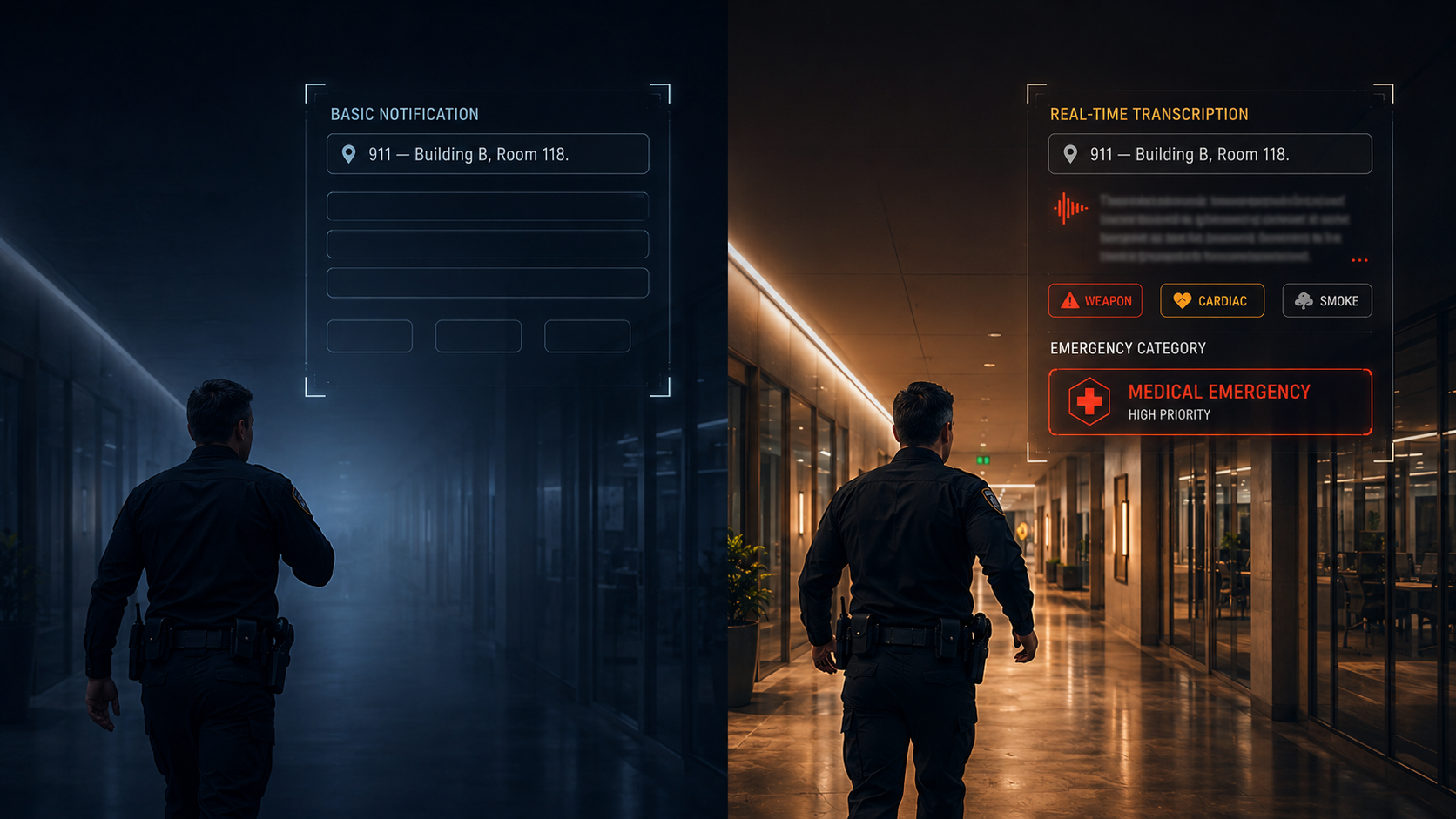
Basic 911 notification tells you where. Real-time transcription tells you what. Here are five scenarios where that difference fundamentally changes how your team responds.
Scenario 1: Active Threat
What basic notification tells you:
911 call placed — Building B, Room 118 — 2:47 PM
What Echo tells you:
🔴 SECURITY — Building B, Room 118 — 2:47 PM
Keywords detected: weapon, threatening, hiding
Transcript: "...there's a man with a knife... he's threatening people... we're hiding in the conference room..."
How response changes:
With basic notification, your team approaches Room 118 like any other 911 call. They might walk in expecting a medical situation or a false alarm. They're not prepared for a threat.
With Echo, your team knows before they arrive:
- There's a weapon involved
- Multiple people are at risk
- Potential victims are hiding, which means the threat may be mobile
- This requires coordinated response, not a solo check
They don't approach the room directly. They coordinate with other security personnel. They initiate lockdown procedures for adjacent areas. They brief arriving law enforcement with specific details: "Knife, threatening multiple people, victims sheltering in the conference room."
The response isn't just faster — it's fundamentally different.
Scenario 2: Cardiac Emergency vs. Other Medical
What basic notification tells you:
911 call placed — Building A, Floor 3, Cubicle Area — 10:22 AM
What Echo tells you:
🔴 MEDICAL — Building A, Floor 3, Cubicle Area — 10:22 AM
Keywords detected: chest pain, not breathing, collapsed
Transcript: "...he grabbed his chest and just fell... he's not breathing... I don't think he has a pulse..."
How response changes:
Medical emergencies aren't all the same. A cardiac arrest requires immediate intervention — brain damage begins within 4-6 minutes without oxygen. A broken ankle is serious but not time-critical.
With basic notification, your team grabs a first aid kit and heads to Floor 3. They'll figure out what's needed when they arrive.
With Echo, your team knows this is cardiac. They grab the AED from the wall mount on their way. They move at a sprint, not a jog. Someone else is dispatched to meet EMS at the building entrance to guide them directly to the location.
Those saved seconds matter. In cardiac arrest, every minute without defibrillation reduces survival odds by 7-10%. Knowing it's cardiac before arrival — not after — can be the difference between a save and a loss.
Scenario 3: Fire vs. False Alarm
What basic notification tells you:
911 call placed — Building C, Break Room — 11:45 AM
What Echo tells you:
🔴 FIRE — Building C, Break Room — 11:45 AM
Keywords detected: smoke, fire, burning
Transcript: "...there's smoke coming from the microwave... something's on fire... it's spreading to the cabinets..."
How response changes:
Your organization has fire drills. Everyone knows the evacuation routes. But initiating a full building evacuation is disruptive and expensive — and most 911 calls from break rooms are minor incidents or false alarms.
With basic notification, your team arrives to assess. If it's serious, they initiate evacuation. If it's burnt popcorn, everyone goes back to work. But that assessment takes time — time during which a real fire is growing.
With Echo, your team knows there's actual fire spreading before they arrive. They can initiate evacuation procedures immediately. They grab fire extinguishers on the way. They alert facilities to shut down HVAC in that zone to prevent smoke spread.
And when it is just burnt popcorn? Echo's transcript makes that clear too: "...the microwave is smoking... I think someone left their lunch in too long..." Your team responds appropriately without over-reacting.
Scenario 4: Mental Health Crisis
What basic notification tells you:
911 call placed — Building D, Restroom, Floor 2 — 3:15 PM
What Echo tells you:
🟡 MEDICAL/WELFARE — Building D, Restroom, Floor 2 — 3:15 PM
Keywords detected: hurt themselves, blood, scared
Transcript: "...I found someone in the bathroom... I think they hurt themselves... there's blood... they're conscious but not responding to me..."
How response changes:
Mental health emergencies require a different approach than physical emergencies. Someone in crisis needs calm, trained intervention — not a tactical response that could escalate the situation.
With basic notification, your team doesn't know what they're walking into. They might approach with urgency that feels threatening to someone already in distress. They might not bring the right resources or people.
With Echo, your team understands the nature of the situation. They approach calmly. They ensure someone with crisis intervention training is part of the response. They're prepared with appropriate first aid supplies. They know to create space and reduce stimulation rather than crowd the scene.
The person in crisis gets the response they need — not the response your team would give to a different emergency.
Scenario 5: Multi-Victim Incident
What basic notification tells you:
911 call placed — Parking Garage, Level 2 — 5:30 PM
What Echo tells you:
🔴 ACCIDENT — Parking Garage, Level 2 — 5:30 PM
Keywords detected: accident, multiple people, trapped
Transcript: "...a car hit several people... at least three are down... one is trapped under the vehicle... we need ambulances..."
How response changes:
A single-victim incident and a multi-victim incident require completely different resource levels. One security officer can assist with a single injury. Three or more victims overwhelms any solo responder.
With basic notification, your team sends whoever's available. They arrive to find a mass casualty scene and immediately need backup — backup that's now minutes away instead of already en route.
With Echo, your team knows the scale immediately. Multiple responders are dispatched from the start. Someone is sent to the garage entrance to direct EMS to the exact location. Additional personnel are alerted to prepare for a surge of concerned coworkers and family members. Leadership is notified that this is a significant incident, not a routine call.
The response scales to the emergency from the first moment — not after precious minutes of assessment.
The Pattern Across All Five
Look at what changes in each scenario:
Equipment: The right tools are in hand before arrival — AED for cardiac, extinguisher for fire, appropriate supplies for each situation.
Approach: The team's posture matches the emergency — tactical for threats, calm for mental health, urgent for cardiac.
Scale: The right number of responders are dispatched from the start — not adjusted after arrival reveals the true scope.
Coordination: External responders (police, fire, EMS) get briefed with real information, not just a location ping.
Speed: Decisions that would normally happen after arrival happen before arrival. Assessment time drops to zero.
None of this is possible with basic notification. You can't prepare for what you don't know. You can't scale to what you can't see. You can't brief on details you don't have.
How Echo Makes This Possible
Echo monitors 911 calls as they happen — not after they end. As words are spoken, they're transcribed in real time. AI-powered detection identifies keywords and phrases that indicate emergency type, severity, and specific hazards.
When a match is detected, Echo fires an alert containing:
- Emergency category (medical, fire, security, etc.)
- Matched keywords
- Transcript snippet with context
- Timestamp and confidence score
Your team sees what kind of emergency they're responding to before they arrive. Not a guess. Not an assumption. Actual words from the actual call.
And because Echo uses semantic analysis alongside literal keyword matching, it catches what rigid pattern matching would miss. "He grabbed his chest and collapsed" triggers the same cardiac alert as "heart attack" — even though the caller never used those exact words.
Your Emergencies Are Already Happening
Somewhere in your organization, the next 911 call is coming. It might be cardiac. It might be a threat. It might be a fire or an accident or a crisis.
Your team is going to respond. The question is whether they respond informed or uninformed. Whether they arrive prepared or arrive guessing. Whether they have seconds of advantage or minutes of delay.
Basic notification tells them where to go. Echo tells them what they're walking into.
The scenarios above aren't hypothetical. They're happening in organizations every day. The only variable is whether the responding team has the information they need.
Five scenarios. Five different emergencies. One difference that changes everything: knowing what's happening while it's still happening.