Yes. When someone calls 911 from a cell phone, the wireless carrier sends the caller's phone number and location to the 911 center that answers. Today that location is often accurate to within a few dozen meters, and in many places it includes the caller's height above the ground. But it goes to one place: the 911 center. If the call comes from your campus, hospital, or office park, your own security team isn't told. This guide explains how 911 finds a cell phone caller, how accurate that location is, and why the people closest to the emergency are often the last to know.
The short answer
- Can 911 see your location? Yes. Carriers are required to send location with wireless 911 calls.
- How precise is it? The FCC's rules call for horizontal location within 50 meters for 80% of wireless 911 calls, and vertical location within 3 meters for 80% of calls from phones that support it, in the largest markets.
- Who gets it? The 911 center that handles the call. Nobody else is notified by default.
How 911 gets your location
The FCC built wireless 911 location in two phases. Under Phase I, carriers send the 911 center the caller's phone number and the location of the cell site handling the call. Under Phase II, carriers send more precise information: the caller's latitude and longitude (FCC).
A cell site can cover a wide area, so Phase I alone often leaves dispatchers searching. Phase II is what lets a dispatcher see a point on a map instead of a neighborhood.
How accurate is it?
The FCC has tightened its accuracy rules over time. By April 3, 2021, nationwide carriers had to provide either horizontal location within 50 meters or a dispatchable location for 80% of all wireless 911 calls (FCC).
Height matters too, because a point on a map doesn't tell responders which floor of a building to search. In 2019 the FCC adopted a vertical (z-axis) accuracy standard of plus or minus 3 meters for 80% of indoor wireless 911 calls from phones that support it. It required nationwide carriers to deploy either that z-axis technology or dispatchable location in the top 25 markets by April 3, 2021, and in the top 50 by April 3, 2023 (Federal Register). The FCC also extended privacy protections to that vertical location data.
Three meters is roughly one floor. In practice, that means a 911 center may be able to tell the difference between a caller on the ground floor of a parking garage and one on the fourth level.
How the call reaches the right 911 center
Location also decides where the call goes. Historically, wireless 911 calls were routed based on the cell tower that picked them up, which could send a call to the wrong 911 center when a caller was near a jurisdictional line. In 2024 the FCC required carriers to route wireless 911 calls using the location of the caller's device when that location is accurate and timely (GAO). Nationwide carriers had to do this for 911 voice calls on their 4G and 5G networks by November 13, 2024, and other carriers by May 13, 2026 (FCC).
So who else finds out?
By default, no one. The caller's location goes to the 911 center that answers. The 911 center dispatches police, fire, or EMS. Your security office, campus police, or front desk isn't part of that chain.
That's a real gap for organizations with a campus. Your team knows which garage has a locked stairwell, which building has an AED, and which entrance gets an ambulance closest to a patient. They may be minutes or even seconds away. But unless the 911 center calls them, or someone happens to hear the sirens, they don't know the call happened.
Why your desk phones and cell phones are different
For business phone systems, federal law already closes part of this gap. Under Kari's Law, a multi-line telephone system must notify a central location, such as a front desk or security office, when someone dials 911 (FCC). Our guides to what counts as an MLTS and Kari's Law and RAY BAUM's Act explain those rules.
That notification requirement covers the phones on your phone system. It doesn't cover the personal cell phones of students, patients, visitors, employees, and contractors on your property. A 911 call from a desk phone in a lobby alerts your team. The same call from a visitor's cell phone, a few feet away, doesn't.
How organizations close the gap
Organizations usually try one of three approaches:
- Ask the 911 center to call you. Some 911 centers will notify a campus police department or security office, but it depends on the center, the call volume, and whether the dispatcher knows the caller is on your property.
- Rely on a safety app. Campus safety apps are useful, but they depend on people having the app and remembering to open it under stress. Visitors almost never have it.
- Get alerted when 911 is dialed on your property. Geofence-based alerting draws a boundary around your buildings, lots, and grounds, and notifies your team when a 911 call comes from a cell phone inside it.
The third approach is the only one that doesn't depend on the caller doing anything differently. They dial 911 the way they always would, and the 911 center still handles the call.
How 9Line Pinpoint works
9Line Pinpoint lets you draw geofences around the places you're responsible for: buildings, parking structures, athletic venues, and outdoor spaces. When someone dials 911 from a cell phone inside one of those zones, Pinpoint alerts your on-site team right away.
- Location in three dimensions. Each alert includes the caller's coordinates, including altitude, so your responders know where to go and how high up in a building to look.
- A link back to your team. Pinpoint sends your security team's contact information to the 911 center, so the dispatcher handling the call can reach the people already on site.
- Nothing for callers to install. There's no app and no registration. It works with the phone's native 911 dialing, on Apple and Android.
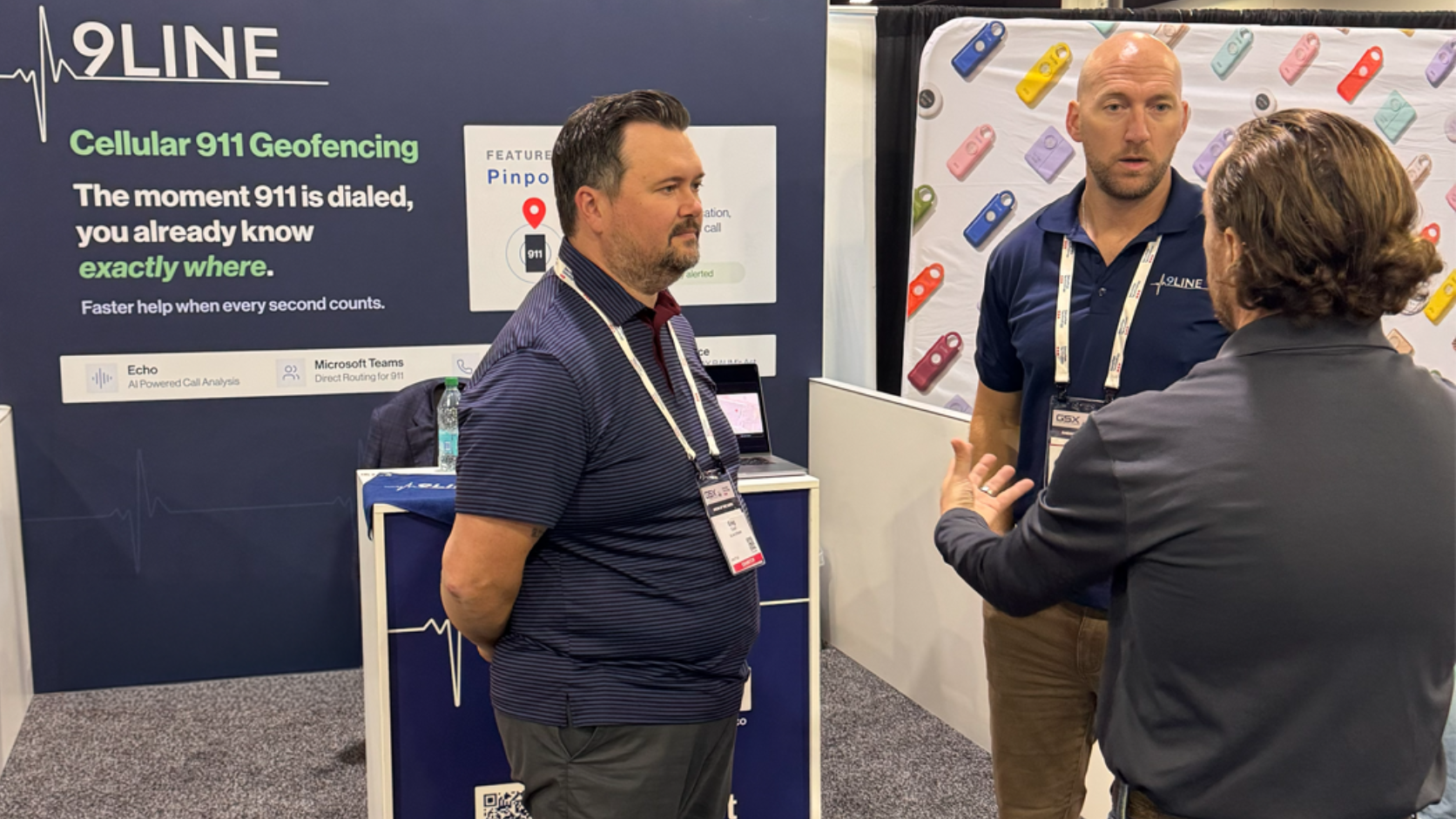
We heard the same story over and over from security leaders at GSX this year: they rarely know when a cell phone 911 call happens on their property. Here's what they told us.
Frequently asked questions
Can 911 track your location?
When you call 911 from a cell phone, your carrier sends your location to the 911 center that answers the call. FCC rules require carriers to provide that location and set accuracy standards for it.
Does 911 know your location if you can't speak?
Yes. The location is sent with the call, so a dispatcher can see it even if the caller can't say where they are. Text-to-911 and real-time text can also help when a caller can't talk.
How accurate is 911 location from a cell phone?
FCC rules call for horizontal location within 50 meters for 80% of wireless 911 calls, and vertical location within 3 meters for 80% of calls from phones that support it in the largest markets.
Is campus security notified when someone calls 911 from a cell phone?
Not automatically. The location goes to the 911 center. Unless the 911 center calls your team, or you use a service that alerts you when 911 is dialed on your property, your security staff won't know about the call.
Sources
- Federal Communications Commission, Wireless E911 Phase I and Phase II.
- Federal Communications Commission, Indoor Location Accuracy Timeline and Benchmarks.
- Federal Register, Wireless E911 Location Accuracy Requirements, 85 FR 2660 (January 16, 2020).
- U.S. Government Accountability Office, Federal Communications Commission: Location-Based Routing for Wireless 911 Calls (B-336126).
- Federal Communications Commission, Order on Location-Based Routing for Wireless 911 Calls, DA 24-259 (March 14, 2024).
- Federal Communications Commission, Multi-line Telephone Systems: Kari's Law and RAY BAUM'S Act 911 Requirements.