A caller in distress rarely uses the exact word you programmed into your alert system. The question is: does your technology understand what they mean—or only what they say?
The Rise of Real-Time Call Intelligence
Something significant is happening inside emergency communications centers across the country. After years of discussion, AI-powered transcription and keyword detection are moving from pilot programs into live production environments—and doing so quickly.
County-level 911 centers are committing significant budgets to deploy AI transcription technology, citing dispatcher burnout and persistent staffing shortages as driving factors. Major platform providers have launched full emergency communications platforms built around real-time transcription, live video, and AI-powered intelligence extraction. Interoperability tools now allow AI-generated call summaries and transcripts to flow between agencies during live incidents. And recent industry benchmarks have found that more than 75 percent of emergency communications professionals rank real-time alerting for high-risk calls as a critical capability.
The trend is clear: the era of relying solely on what a human ear catches during a fast-moving, high-stress emergency call is giving way to systems that capture, transcribe, and analyze spoken language as it happens. But within this shift, a fundamental question is emerging about how these systems actually detect the words that matter.
The Exact-Match Problem
Most keyword detection systems—whether deployed in a PSAP, an enterprise security operation, or a campus safety center—use some form of exact-match logic. The concept is straightforward: an administrator programs a list of keywords ("gun," "bomb," "fire," "active shooter"), and the system monitors transcribed call audio for those specific terms. When one appears, an alert fires.
Exact-match detection is fast, deterministic, and produces a high-confidence result. If the system hears the word "gun" and "gun" is on the keyword list, the match is 100 percent certain. There is no ambiguity and no processing delay for inference. For clear, textbook threat language, exact match works well.
The problem is that people in crisis don't speak in textbook terms.
Consider these real-world caller phrasings, the kinds of language that emergency communications professionals encounter routinely:
- "He's got something—I think it's a weapon" — but exact match needs to hear "gun"
- "She's threatening to hurt herself" — but exact match needs "suicide" or "self-harm"
- "There's a package and it smells like chemicals" — but exact match needs "bomb" or "explosive"
- "He said he's going to do something terrible to everyone here" — but exact match needs "active shooter" or "threat"
- "I can see flames coming from the back of the building" — but exact match needs "fire"
- "She has a firearm and she's waving it around" — but exact match needs "gun"
In the first example, the caller describes a weapon without ever using the word "gun." In the fourth, the caller communicates a mass-casualty threat without saying "active shooter" or "threat." In the sixth, the caller says "firearm"—a synonym that an exact-match system would only catch if someone thought to add it to the keyword list.
This is the exact-match gap: the distance between what a caller means and what a keyword list contains. In low-stress, controlled environments, that gap may be narrow. In real emergencies—where callers are panicked, whispering, crying, using regional dialects, or speaking in fragmented sentences—the gap widens significantly.
What Semantic Analysis Changes
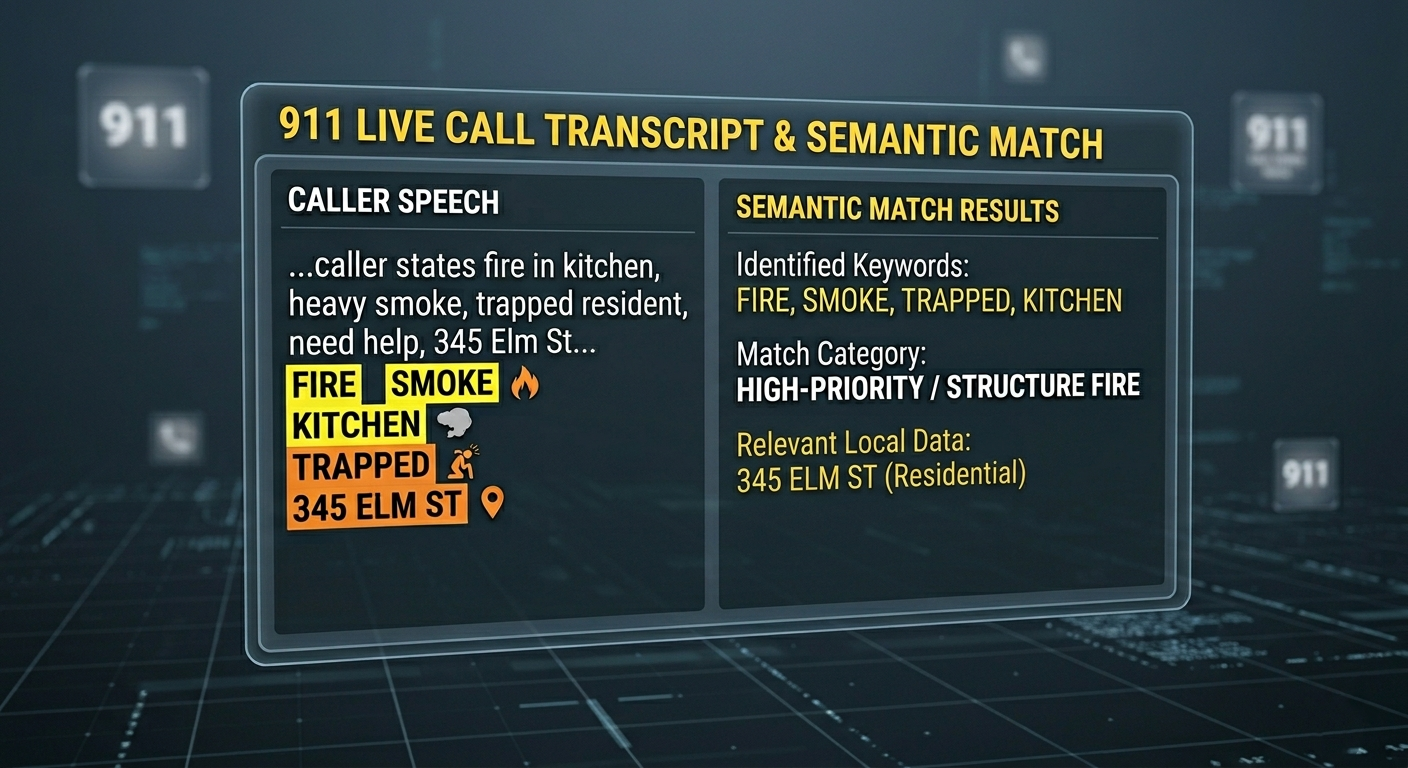
Semantic keyword detection takes a fundamentally different approach. Rather than matching transcribed words against a static list, semantic analysis evaluates the meaning of what is being said in context. It uses natural language processing models trained to understand relationships between words, concepts, and intent—so that when a caller says "firearm," the system recognizes it as conceptually related to "gun," even though the exact string doesn't match.
This is not a new concept in the broader AI and natural language processing landscape. Semantic analysis has been used in cybersecurity threat intelligence, customer service automation, and content moderation for years. What's new is its application to live, high-stakes emergency communications environments where accuracy, speed, and low false-positive rates are non-negotiable.
The practical value of semantic detection becomes clear when you consider how it would handle the caller scenarios above. A semantic engine processing the phrase "He's got something—I think it's a weapon" can recognize that "weapon" is semantically related to keywords like "gun," "firearm," and "armed," and flag it accordingly. Similarly, "She's threatening to hurt herself" maps to the concept of self-harm even without the exact clinical term.
The result is a system that catches threats exact match misses—without requiring administrators to anticipate every possible synonym, euphemism, or circumlocution a caller might use.
The Case for Dual-Layer Intelligence
The most effective approach to keyword detection in emergency environments isn't exact match or semantic analysis in isolation—it's both working together.
Here's why. Exact-match detection excels at speed and certainty. When a caller says the precise keyword on the list, the match is instantaneous and 100 percent confident. There is no inference step and no ambiguity. For the clearest, most explicit threat language, exact match is the fastest path to an alert.
Semantic analysis excels at coverage and context. It catches the synonyms, the indirect references, and the emotionally charged language that exact match cannot. But because it involves inference—the system is interpreting meaning, not just matching strings—it operates at a confidence level rather than a binary yes/no. A well-designed semantic engine will report that a phrase is, say, 87 percent likely to be related to the keyword "gun," giving security teams the information they need to evaluate the alert in context.
A dual-layer system combines these strengths. The exact-match layer provides an immediate, deterministic catch for explicit keywords. The semantic layer runs in parallel, periodically analyzing the broader transcript for conceptual matches that the exact-match layer wouldn't flag. Together, they create a detection surface that is both fast and comprehensive—and that reduces the likelihood of a critical threat going undetected because a caller chose an unexpected word.
Why This Matters Now
The convergence of several industry trends makes dual-layer keyword detection particularly relevant in 2026.
AI transcription is entering production. County-level 911 centers, major platform providers, and enterprise safety operations are all investing in real-time transcription. But transcription without intelligent analysis is just a searchable recording. The value comes from what the system does with the transcript while the call is still happening.
PSAP professionals are demanding real-time alerting. Recent industry benchmarks have found that high-risk call alerting is the number-one use case emergency communications professionals want from AI transcription—above keyword searching, live monitoring, and automated note-taking. The appetite for this capability is established; the question is whether the detection logic behind the alert is good enough to catch the threats that matter.
Enterprise E911 compliance is tightening. The FCC has signaled a shift from education to enforcement on Kari's Law and RAY BAUM's Act compliance. Organizations that already meet minimum requirements—direct 911 dialing, on-site notification, dispatchable location—are now asking what else they can do to strengthen their emergency communications posture. Real-time call intelligence, including transcription and keyword alerting, is a natural next step.
Campus and workplace safety programs are integrating AI. Higher education institutions and healthcare organizations are investing heavily in AI-enhanced security platforms that combine video surveillance, access control, behavioral threat assessment, and automated alerting. The emergency call itself—what is said during the 911 call from campus—is an underutilized data source in most of these integrated security ecosystems.
What to Look For in a Keyword Detection Solution
For organizations evaluating keyword detection as part of their emergency communications or security infrastructure, several capabilities separate mature solutions from basic implementations:
- Dual detection layers: Does the system combine exact-match (literal) detection with AI-powered semantic analysis? Or does it rely on one method alone?
- Confidence scoring: For semantic matches, does the system report a confidence level? This is critical for reducing false positives and giving security teams the context to evaluate alerts quickly.
- Match type transparency: When an alert fires, does the system tell you whether the match was literal or semantic? This distinction matters for triage and documentation.
- Infrastructure integration: Does the keyword detection run natively within your existing call infrastructure, or does it require bolt-on hardware and separate platforms? Solutions that operate within the existing SBC or telephony environment minimize deployment complexity and reduce points of failure.
- Per-organization control: Can each organization manage its own keyword lists, enable or disable recording and transcription independently, and assign roles with appropriate permissions? One-size-fits-all configurations rarely serve diverse enterprise and campus environments.
- Noisy environment accuracy: Emergency calls are not clean audio. Systems must be designed to perform accurately when callers are panicked, background noise is high, and speech is fragmented or unclear.
The Bottom Line
The emergency communications industry is moving toward real-time call intelligence at an accelerating pace. AI-powered transcription is no longer experimental—it is being deployed in production 911 environments and enterprise security operations today.
But transcription alone is not enough. The detection logic that sits on top of the transcript determines whether the system catches a threat that's described in plain language or misses it because the caller didn't use the right word. Exact-match keyword detection is a necessary foundation, but it leaves gaps that are predictable and preventable.
Semantic keyword detection closes those gaps by understanding meaning, not just matching strings. And a dual-layer approach—combining the speed and certainty of exact match with the coverage and contextual understanding of semantic analysis—gives security teams the most complete detection surface available.
In an emergency, the difference between catching a threat and missing it can come down to a single word. The technology should be smart enough to catch it either way.
9Line's Echo capability brings dual-layer keyword detection—literal matching plus AI-powered semantic analysis—natively into the 9Line SBC infrastructure. Echo is currently in development. Join the waitlist to learn more.