A senior living community can place more 911 calls in a month than an office tower places in a year — and the caller is often the least able to say where they are. That combination turns E911 compliance from a paperwork exercise into a daily safety system.
Most 911 compliance conversations assume a workplace: employees who know the address, a manageable call volume, and a building or two. Senior living breaks all three assumptions at once. The call volume is high, the callers are vulnerable, and the “building” is often a sprawling campus of independent living, assisted living, memory care, and skilled nursing. The stakes aren’t hypothetical — they’re Tuesday.
High call volume, high stakes
Falls, cardiac events, strokes, breathing emergencies — the events that drive 911 calls are simply more frequent in a community of older residents. Every one of those calls is a race, and the margin between a good and a bad outcome is often measured in the minutes it takes responders to reach the right person. A 911 system that’s “good enough” for a low-volume office is operating under entirely different pressure here.
The caller often can’t tell anyone where they are
A resident in distress may be disoriented, cognitively impaired, hard to understand, or unable to recall their own unit number under stress. Some can’t speak at all by the time the line connects. Every part of a response plan that quietly depends on the caller stating their location fails in exactly the population that needs it most. The dispatchable location can’t come from the resident. It has to come from the system.
The address is a campus, not a building
“123 Elm Street” doesn’t help a paramedic when the property spans multiple residential buildings, a memory care wing, common areas, a dining hall, and a health center across several acres. Responders need a dispatchable location precise to the unit or zone, delivered with the call, so they’re heading to the right door instead of searching a campus while the clock runs.
Lean overnight staffing, just like the rest of hospitality’s hardest hours
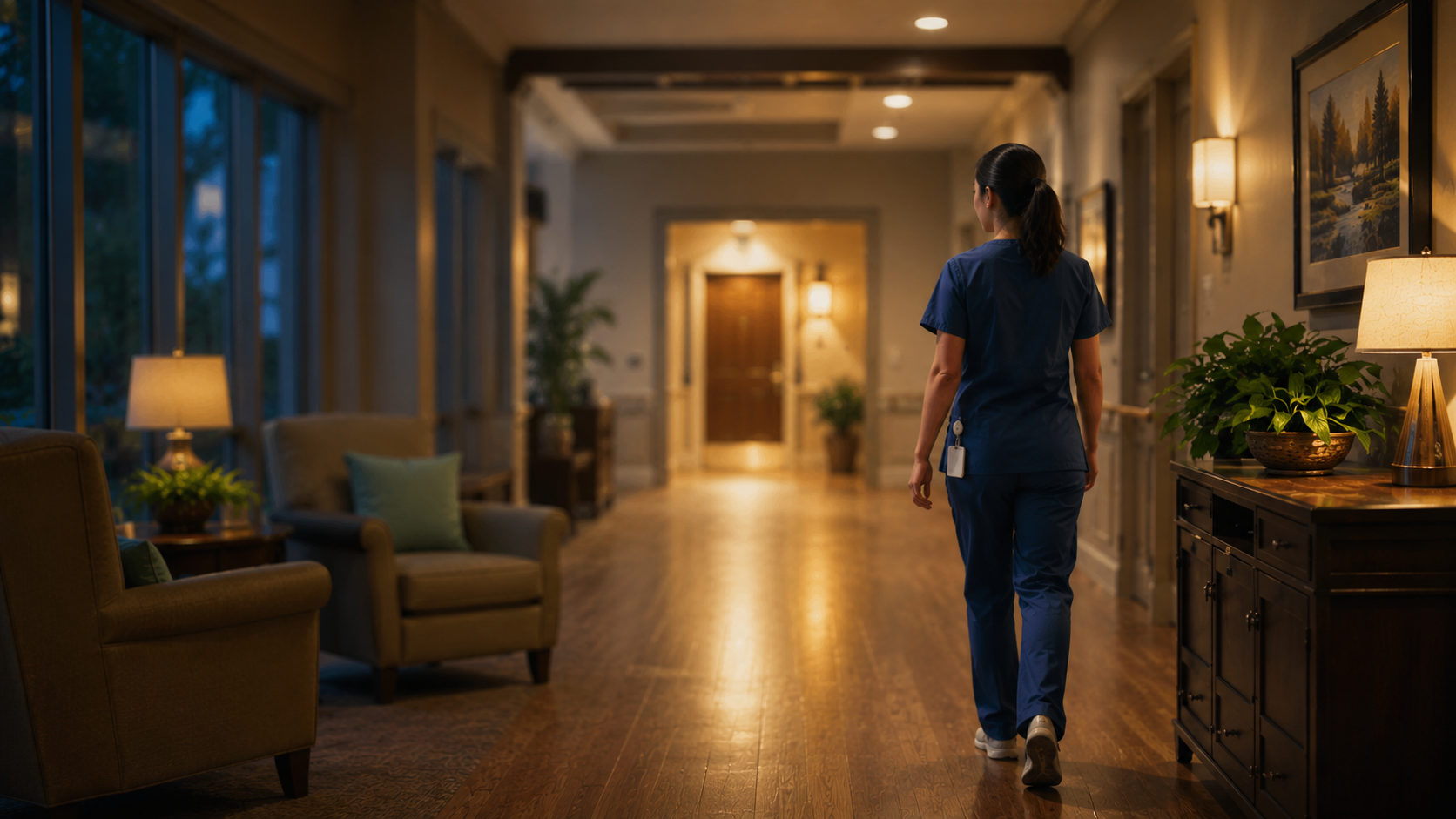
Overnight, a handful of caregivers may cover dozens or hundreds of units. The person who can respond fastest is whoever is already on the floor — which means the notification has to reach the device in their hand, not a workstation at an unstaffed front desk. If the alert lands somewhere nobody is watching, the closest responder never learns the call happened.
Why understanding the call matters even more here
A fall, a cardiac arrest, a choking episode, and a resident who has wandered each demand a different response and different equipment. Staff who know which one they’re walking into can bring the AED instead of the master key, or call for the right backup before they arrive. Because 9Line sits in the call path, Echo transcribes the 911 call in real time and surfaces what’s being said to on-shift caregivers — turning a unit number on a screen into a head start.
Here’s what that looks like in practice. The moment a resident dials 911, the call runs through 9Line, so Echo begins transcribing the instant the line connects — there’s nothing for the resident to open, find, or remember, and nothing new to install on the network. As dispatch and the resident speak, that conversation streams to the caregivers on shift, on the mobile devices already in their hands. A bare notification can tell a caregiver only that a call came from unit 214; Echo tells them the resident reported chest pain, that a neighbor is describing a fall, or that no one on the line is answering at all. That context shapes the response before anyone reaches the door — the right equipment, the right number of hands, and a clear call on whether to begin care immediately or guide EMS straight to the unit. It also leaves a record: a timestamped, written account of what was said on the call, useful for the shift handoff, the family conversation, and the incident review that follows.
And because Echo rides on the call path 9Line already manages, a community gets that real-time picture without resident-worn pendants, new handsets, or anything an older resident has to learn. The same infrastructure that keeps the community compliant — direct dialing, accurate dispatchable location, alerting to the right people — is what makes the live understanding possible. Compliance and response stop being two separate systems and become one.
What readiness looks like for a community
- Direct 911 dialing from every phone — resident units, common areas, and staff stations, with no prefix.
- Dispatchable location precise to the unit or zone — because the resident can’t provide it and the campus is too large for a street address to mean anything.
- Notification to the caregiver actually on the floor — on the mobile device they carry, not a desk nobody is staffing at 3 a.m.
- Real-time understanding of the call — so staff bring the right response to the right door the first time.
Senior living sits at the intersection of high call volume, vulnerable callers, and complex campuses — the exact conditions where the gap between “a call happened” and “here’s what’s happening and where” decides outcomes. Compliance is the floor. For the people in your care, the goal is the ceiling.
Request an Echo demo and see what real-time understanding looks like for a community where every minute counts.
9Line Software is the cloud-based E911 compliance platform built for Cisco Call Manager, Microsoft Teams, and BroadWorks. Echo, 9Line’s AI-powered transcription and alerting service, is made possible because 9Line sits in the call path — where safety actually gets handled.