Over the past decade, enterprises have invested heavily in 911 notification systems. When someone dials 911 from a corporate phone, security teams receive instant alerts. Facilities managers get notified. In sophisticated deployments, digital signage updates, mass notification systems activate, and designated responders receive push notifications on their mobile devices.
These systems represent genuine progress. Compared to the days when 911 calls happened invisibly, with no one on-site aware until first responders arrived asking questions, today's notification infrastructure is a major advancement.
But notification is only the foundation. Knowing that a 911 call occurred tells you nothing about what kind of emergency you're facing, how serious it is, or how your response should adapt.
The industry has treated alerting as the finish line when it's really the starting point. Alerting and awareness are not the same thing. And as organizations mature their emergency response capabilities, the gap between them becomes increasingly consequential.
The Evolution of Enterprise 911
To understand where we're headed, it helps to see where we've been.
Phase 1: Basic Connectivity. In the early days of enterprise telephony, 911 compliance meant one thing: making sure calls connected. PBX systems needed to route 911 to the PSAP, and a callback number needed to work. Whether anyone at the organization knew a call was placed was irrelevant to regulators.
Phase 2: Location Accuracy. As enterprises grew more complex — multiple buildings, multiple floors, remote workers — location became critical. Ray Baum's Act codified what PSAPs had been requesting for years: dispatchable locations that could guide first responders directly to the caller, not just the building entrance.
Phase 3: On-Site Notification. Kari's Law introduced the requirement for immediate on-site notification when 911 is dialed. Organizations implemented alerting systems — email notifications, SMS, dedicated consoles for security operations. The goal was closing the awareness gap between the emergency and the organization.
Most organizations today sit somewhere in Phase 3. They've achieved compliance. They receive alerts. They know when 911 calls happen and where they originate.
But Phase 4 is emerging, and it builds on that notification foundation with something more: understanding of what the emergency actually is.
The Limits of Notification Alone
Consider what a typical 911 notification actually tells you:
ALERT: 911 call placed from Building B, Floor 2, Conference Room 204. Extension 2847. User: John Smith.
This is useful information. You know where to go. You might even know who called. But you don't know:
What type of emergency is it? Medical, fire, security, accident? Each demands different resources, different urgency, different response protocols.
How severe is it? A minor injury and a cardiac arrest both generate identical notifications. A small trash can fire and a spreading blaze look the same in your alert queue.
Is it escalating or contained? A situation that's stabilizing needs different treatment than one that's getting worse by the second.
Are there hazards your responders should know about? Weapons, chemical spills, structural damage — information that could save your team's lives.
How many people are affected? One person with a sprained ankle is different from a conference room full of people exposed to something toxic.
Notification systems were designed to tell you that something happened — and they do that well. But that's only half the picture.
What Situational Awareness Actually Means
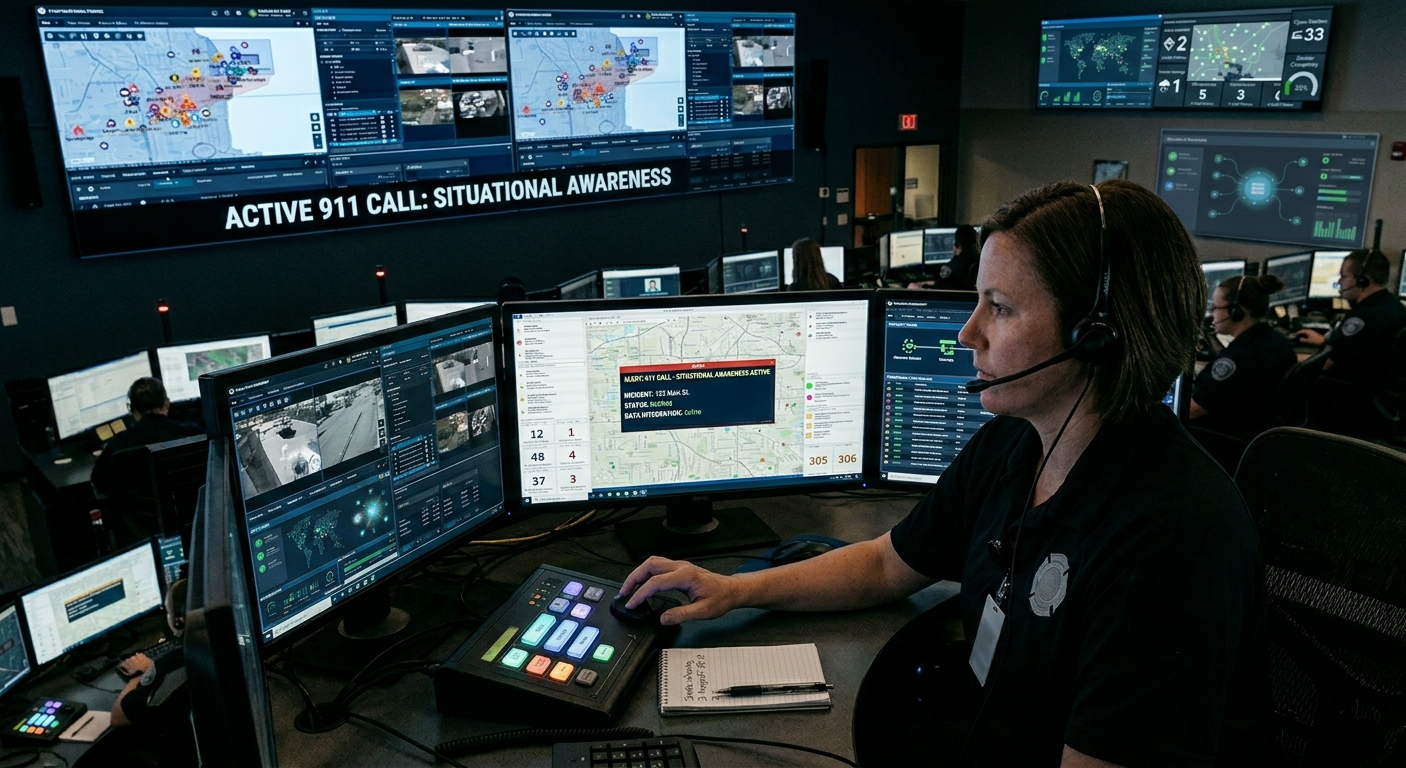
Situational awareness, in emergency response contexts, means having sufficient understanding of a situation to make informed decisions. It's the difference between knowing and understanding, between alerting and comprehending.
The military formalized this concept decades ago. Combat decision-making depends not just on knowing something happened, but on understanding what it means, how it's evolving, and what's likely to happen next. First responders operate with the same framework — their training emphasizes reading scenes, gathering intelligence, and adapting response based on what they learn.
Enterprise security teams have adopted similar principles. Modern security operations centers (SOCs) don't just receive alerts — they correlate data, analyze patterns, and build understanding of unfolding situations before committing resources.
Yet when it comes to 911 calls — arguably the highest-stakes events an organization faces — most enterprises operate with nothing beyond the initial alert. They've applied sophisticated situational awareness to cybersecurity but not to physical emergencies.
The Information Exists
Here's the frustrating reality: the information needed for true situational awareness exists. It's being communicated. It's just not reaching the people who need it.
When someone dials 911, they describe the emergency to the dispatcher. This information flows from caller to PSAP in real time, as the conversation happens.
Dispatchers use this information to coordinate response. They know what type of units to send, how many, and how quickly. They alert responders to specific hazards or circumstances. By the time first responders arrive, they've been briefed on what to expect.
But the organization where the emergency is occurring? They get a notification that a call was placed. The rich, continuously-updating stream of information flowing between caller and dispatcher bypasses them entirely.
This isn't a technical limitation — it's an architectural one. The 911 system wasn't designed with enterprises as stakeholders.
The Cost of the Awareness Gap
Misallocated resources. Without knowing the nature of an emergency, organizations send generic response. Every 911 call might trigger the same security officer walking the same route at the same pace. But emergencies aren't generic. A cardiac arrest needs someone with AED training, not just the nearest available body.
Delayed secondary response. Many emergencies require coordinated action beyond the immediate response. Without knowing what's happening, organizations can't initiate these secondary responses until someone physically reaches the scene and reports back — losing critical minutes.
Responder safety risks. Security teams responding to unknown emergencies can walk into dangerous situations unprepared. A violent incident looks identical to a medical emergency in a notification system.
Communication failures. When leadership asks "what's happening," the honest answer is often "we don't know yet." This uncertainty creates anxiety, delays decision-making, and can lead to either under-reaction or over-reaction.
From Notification to Intelligence
The shift from notification to situational awareness isn't incremental — it's transformational. It changes what organizations can do in the critical first minutes of any emergency.
Differentiated response. Instead of generic response to all 911 calls, organizations can tailor their reaction to specific emergency types. Medical events get medical response. Fires get evacuation coordinators. Threats get appropriate security posture.
Parallel action. While primary responders move toward the emergency, secondary responses can initiate simultaneously. Someone can meet EMS at the door. Evacuation communications can begin. Lockdown procedures can activate.
Informed responders. Teams approaching an emergency know what they're walking into. They can prepare mentally and physically for the specific situation.
Leadership visibility. Executives and crisis managers gain real-time understanding of unfolding situations. They can make informed decisions about business continuity, communications, and resource allocation.
Post-incident clarity. Documented intelligence about what happened and when supports incident review, liability protection, and continuous improvement.
The Technology Inflection Point
For years, the gap between notification and awareness persisted because bridging it was technically impractical. That's no longer true. Several technologies have matured to the point where real-time situational awareness is achievable — and 9Line has combined them into Echo:
Speech-to-text transcription now operates in real time with accuracy exceeding 95%. Conversations can be converted to text as they happen, creating searchable, analyzable records.
Natural language processing can identify key concepts, classify emergency types, and extract critical details from unstructured conversation.
Semantic understanding goes beyond literal keyword matching. AI systems can recognize that different phrases indicate the same type of emergency.
Push notification infrastructure can deliver differentiated alerts to different recipients based on emergency type.
9Line has assembled these pieces into Echo — the only purpose-built solution that delivers real-time 911 call transcription and keyword alerting to enterprise organizations.
Conclusion
The distinction between notification and situational awareness might seem subtle, but its implications are profound. Notification tells you something happened. Awareness tells you what to do about it.
For a decade, enterprises have invested in notification infrastructure — and that investment was essential. It built the foundation that makes everything else possible.
But the next frontier is here. The technology now exists to deliver real-time understanding of emergencies as they unfold. Organizations that build on their notification foundation with true situational awareness will respond faster, more accurately, and more effectively.
911 notification was a critical first step. Real-time situational awareness is what comes next.
Echo from 9Line is the only solution built specifically for that frontier — delivering live 911 call transcription and keyword alerting to the people who need it most, in real time, as the emergency unfolds.
Learn more by visiting: 9Line.net/echo.